In today’s fast-paced world, the convenience of accessing cash right where you live is no longer a luxury—it’s a necessity. For millions in India, especially in suburban and semi-urban neighborhoods, the Aadhaar Enabled Payment System (AEPS) has become a lifeline. It allows you to local AEPS cash withdrawal near residential areas walk to a local kirana store or a business correspondent (BC) agent and withdraw cash using just your Aadhaar number and fingerprint. But with this incredible convenience comes the crucial question of safety. How do you ensure that your local AEPS cash withdrawal near residential areas is secure and your financial data remains protected? This in-depth guide will walk you through everything you need to know, from how AEPS works to smart, safe banking practices you can adopt today.
What is AEPS and Why is it a Game-Changer?
AEPS is a bank-led model that allows you to perform basic banking transactions—cash withdrawal, deposit, balance inquiry, and fund transfers—at micro-ATMs or PoS terminals using only your Aadhaar number and biometric authentication (your fingerprint or iris scan). You don’t need a debit card, PIN, or even your phone.
Its biggest strength is its hyper-local reach. Instead of traveling to a distant bank branch, you can often find an AEPS cash withdrawal near residential areas at a familiar neighborhood shop. This is transformative for the elderly, homemakers, daily wage workers, and anyone who values time and immediate access to their funds.
The Safety Paradox: Convenience vs. Risk at Your Doorstep
The very feature that makes AEPS brilliant—its local availability—also opens up potential risks. A transaction at a busy bank branch is conducted in a controlled environment. A transaction at your local grocery store is not. The risks aren’t inherent to the AEPS technology, which is quite robust, but to the environment and practices around it.
Potential concerns include:
-
Skimming or Copying Biometrics: While difficult, there’s always a fear of fingerprint data being misused.
-
Shoulder Surfing: Someone might watch you enter your Aadhaar number.
-
Fraudulent BC Agents: Rare, but possible, where an unverified agent operates a scam.
-
Technical Glitches & Transaction Disputes: What if money is deducted but cash isn’t dispensed?
-
Lack of Privacy: Conducting financial transactions in a crowded, public shop.
Your Blueprint for Safe Local AEPS Cash Withdrawal
Don’t let the risks deter you. By following these expert-recommended tips, you can enjoy the convenience of AEPS cash withdrawal near residential areas with confidence.
1. Choose Your Withdrawal Point Wisely
Not all local outlets are created equal.
-
Go Established: Prefer shops you know and have frequented for years. A well-known general store or pharmacy is often more reliable than a newly-opened, unknown kiosk.
-
Look for Official Signage: Legitimate BC agents usually display bank-branded posters, boards, or stickers saying “Aadhaar Enabled Banking” or “Micro ATM Services.”
-
Ask in Community Groups: Your local residential welfare association (RWA) group on WhatsApp or Facebook can be a great resource to find recommended and trusted agents.
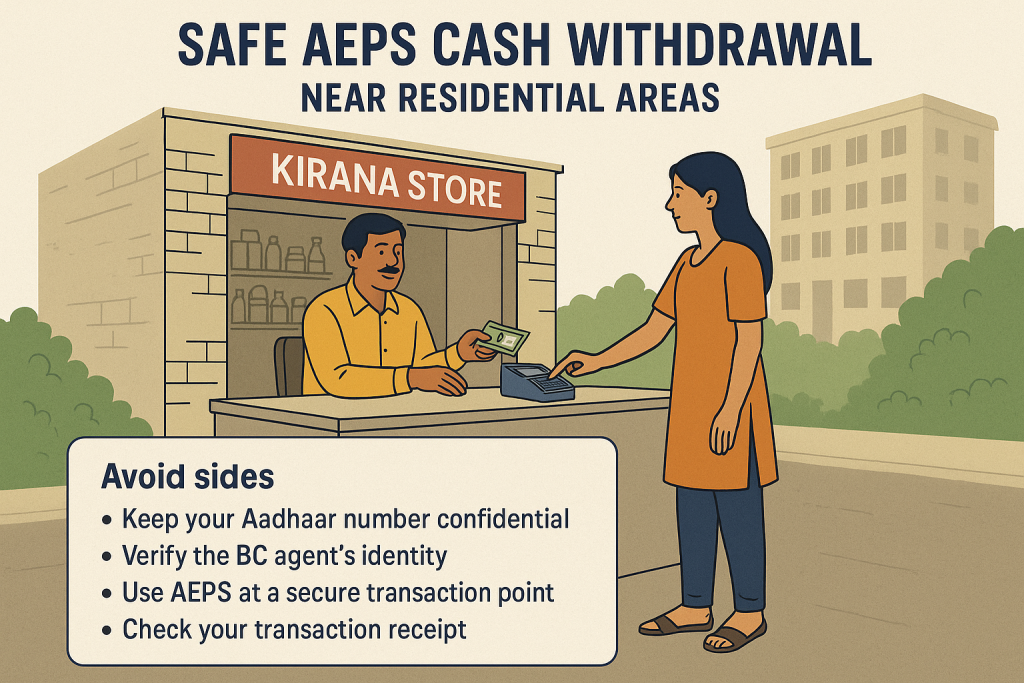

2. Verify the Agent and the Process
A minute of verification can prevent months of hassle.
-
Ask for ID: A genuine Business Correspondent agent should have an ID card issued by the bank they represent. Don’t hesitate to ask to see it.
-
Use Your Own Aadhaar Number: Never hand over a physical copy or a photo of your Aadhaar card. You should be the one dictating the 12-digit number to the agent. Memorize it or keep it in a secure digital notes app.
-
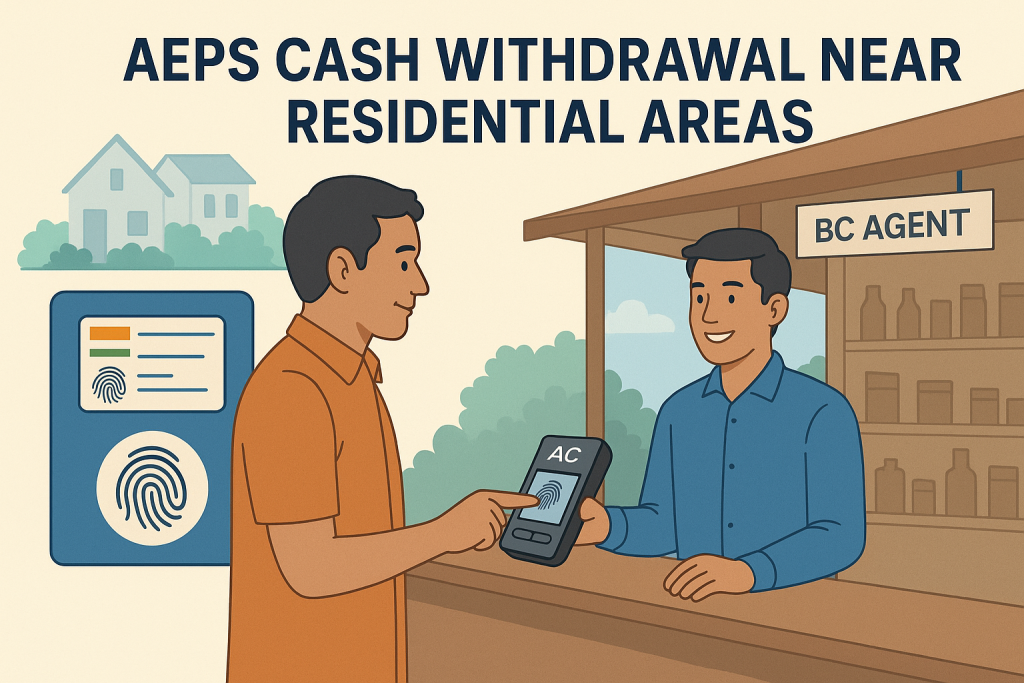
The Fingerprint is Final: Only you should place your finger on the scanner. Never allow the agent to physically guide your finger or use a fingerprint impression on a object. The system is designed to need a live fingerprint.
3. Master the Transaction Etiquette
This is where your vigilance matters most.
-
Demand Privacy: Politely ask if you can move to a slightly less crowded part of the counter. Turn your back to the crowd when entering your Aadhaar number.
-
Watch Every Step: Keep your eyes on the micro-ATM screen. Ensure the transaction type is “Cash Withdrawal” and the amount displayed is correct before you authenticate.
-
Get a Receipt: This is non-negotiable. Every transaction generates a printed receipt. It is your proof of the transaction, containing a unique transaction ID (UTR), date, time, amount, and your bank’s name. Do not leave without it.
-
Count the Cash On-Spot: Count the dispensed cash immediately at the counter before stepping away. If there’s a discrepancy, alert the agent right then.
4. Leverage Technology for Oversight
Your mobile banking app is your best friend for post-transaction safety.
-
Enable Instant SMS Alerts: Ensure your bank sends SMS alerts for every transaction. The alert should come within seconds of completing the AEPS withdrawal.
-
Cross-Check with Bank App/Statement: Once a week, quickly scan your transaction history in your bank app to confirm all AEPS debits match your receipts and memory.
-
Use the NPCI Portal: The National Payments Corporation of India (NPCI) provides a transaction dispute mechanism. Your receipt’s UTR number is key here.
5. Know What to Do If Something Goes Wrong
Despite precautions, issues can occur. Here’s your action plan:
-
Stay Calm and Present: Don’t leave the outlet. Show the agent the SMS alert confirming debit but no cash receipt.
-
Use the Transaction ID: Quote the UTR from your receipt. A legitimate agent can often initiate a reversal for a “transaction reversal” or “cash dispense error.”
-
Escalate to the Bank: If the agent is unhelpful, immediately call your bank’s customer care. Provide them with the UTR number, agent ID, and location. Banks have a defined process to track and resolve AEPS disputes, which typically takes a few working days.
-
File a Grievance: If unresolved, raise a formal complaint on the RBI’s Banking Ombudsman portal.
The Bigger Picture: A Secure Digital Financial Ecosystem
Local AEPS cash withdrawal near residential areas is a cornerstone of financial inclusion. As per a 2023 report by NPCI, AEPS processes over 80-90 million transactions monthly, underscoring its deep penetration. Its safety relies on a triad: robust technology from NPCI, responsible banking partners, and informed, vigilant users like you.
By treating your biometric data like your ATM PIN—private and non-shareable—and by adopting the habits outlined above, you transform from a passive user to an empowered participant in India’s digital finance story.
Frequently Asked Questions (FAQs)
Q1: Is it safe to share my Aadhaar number for AEPS withdrawal?
A: For AEPS, you must share your Aadhaar number with the banking system to authenticate. The key is to verbally state it or enter it yourself on a keypad. Never hand over a physical or digital copy of your Aadhaar card for a simple cash withdrawal, as it can be misused for other purposes.
Q2. What if the AEPS machine says “Transaction Failed” but I got an SMS for debit?
A: This is a “transaction reversal” scenario. First, show the SMS to the agent and ask for a reversal. Always collect the transaction slip, even for a failed transaction, as it has the UTR. If the cash isn’t reversed on the spot, contact your bank with the UTR immediately. The amount is usually credited back within 3-7 working days.
Q3. Can someone steal money from my account using a copy of my fingerprint?
A: The AEPS system uses live biometric authentication. It requires a real, living fingerprint with blood flow and electrical conductivity. A photocopy, photograph, or even a lifted fingerprint impression on tape is highly unlikely to work on certified micro-ATM devices. The real risk is you being tricked into placing your finger on a scanner for an unauthorized transaction.
Q4. Are there daily limits for AEPS withdrawals?
A: Yes, to enhance security. The limit is set by your bank and typically ranges from ₹10,000 to ₹50,000 per day. Check with your specific bank for the exact limit on your account type.
Q5. How do I find a legitimate AEPS agent near my home?
A: You can use your bank’s website or mobile app, which often have a “locate a BC agent” feature. Alternatively, ask your bank branch for a list of authorized agents in your locality. Word-of-mouth from trusted neighbors is also a reliable method.
Disclaimer: This article is for educational and informational purposes only. It is not intended as financial, legal, or security advice. While every effort has been made to ensure accuracy, banking protocols and technology evolve. Readers are advised to exercise their own diligence and consult with their financial institution for the latest guidelines and dispute resolution procedures. The practices of individual BC agents are not under our control. If you have any concerns regarding the content of this post, including ownership or copyright issues, please refer to the standard DMCA takedown process and contact the appropriate administrative channel for resolution. Always verify the credentials of any financial service provider before transacting.