Buying gold jewelry is an emotional and financial milestone for many. However, the (calculate gold price ) final price tag often comes as a shock, far exceeding the simple “gold rate” you see in the newspaper. This confusion primarily stems from two critical additions: Making Charges and the Goods and Services Tax (GST). To make an informed and confident purchase, you must learn how to calculate gold price with these components. This guide will break down the entire calculation process, demystify industry terms, and empower you to understand exactly what you’re paying for.
Breaking Down the Final Bill: The Three Components
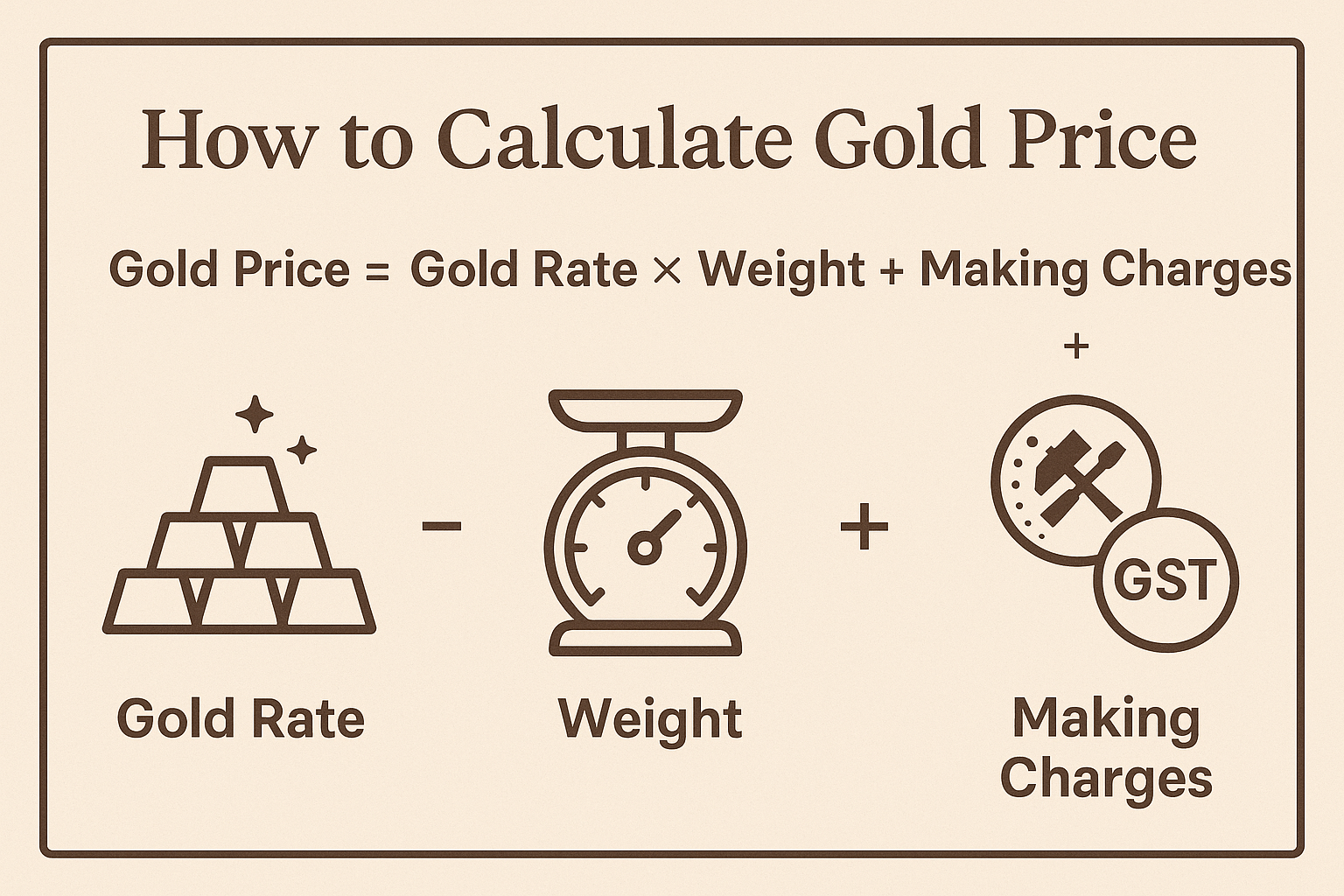
When you buy a piece of gold jewelry, its final price is not just based on its weight. It is a sum of three distinct elements:
-
The Cost of Gold: The base value of the raw gold.
-
The Making Charges (MC): The cost of craftsmanship.
-
The Goods and Services Tax (GST): The government-mandated tax.
Let’s explore each component in detail.
1. The Cost of Gold: Purity and Weight
The foundational element is the value of the gold itself, determined by its weight and purity.
-
Weight: Measured in grams. Jewelers use standard 10-gram weights for measurement.
-
Purity: Measured in karats (K). 24K gold is considered pure (99.9% gold). However, 24K gold is too soft for jewelry, so it’s alloyed with other metals to make it durable. The most common purities for jewelry are:
-
22K: 91.6% pure gold ( hallmark symbol: 916)
-
18K: 75.0% pure gold ( hallmark symbol: 750)
-
14K: 58.3% pure gold ( hallmark symbol: 583)
-
The day’s gold rate is typically quoted for 10 grams of 24K gold. To find the cost of your jewelry’s gold content, you need to adjust for its purity.
Formula: Cost of Gold in Jewelry = (Gold Rate per gram) x (Purity in % / 100) x Weight (g)
Example: If the daily gold rate is ₹6,000 per gram for 24K gold, and you are buying a 22K gold chain weighing 15 grams.
-
Purity of 22K = 91.6% or 0.916
-
Cost of Gold = ₹6,000 x 0.916 x 15 = ₹82,440
This (₹82,440) is the value of the raw gold in your chain.

2. Making Charges: Paying for the Craftsmanship
Making charges, also called making fees or labor charges, are what the jeweler charges for designing and crafting the piece. This is where prices can vary dramatically.
-
How are they calculated? There are two primary methods:
-
Percentage Method: A percentage of the cost of gold. This is the most common method. It can range from 8% to 25% or even higher depending on the complexity of the design. Intricate, handcrafted pieces like Kundan or Jadau work will be at the top end of this scale, while simple bands will be at the lower end.
-
Flat Rate per Gram: A fixed charge per gram of gold used. For instance, ₹500 per gram. This method is often used for simpler machine-made designs.
-
Example (Continuing from above): Let’s assume the jeweller charges making charges at 12% of the gold cost.
-
Making Charges = 12% of ₹82,440 = ₹9,892.80
3. Goods and Services Tax (GST): The Government’s Share
The Indian government levies a tax on gold jewelry, which is applied after the making charges are added. The GST structure for gold is two-fold:
-
GST on Gold (Value): A 3% GST is applied on the total value of the gold (the ₹82,440 in our example).
-
GST on Making Charges (Service): A 5% GST is applied on the total making charges (the ₹9,892.80 in our example).
This is a crucial point many miss. The making charges are treated as a “service,” attracting a different tax rate.
Putting It All Together: The Grand Calculation
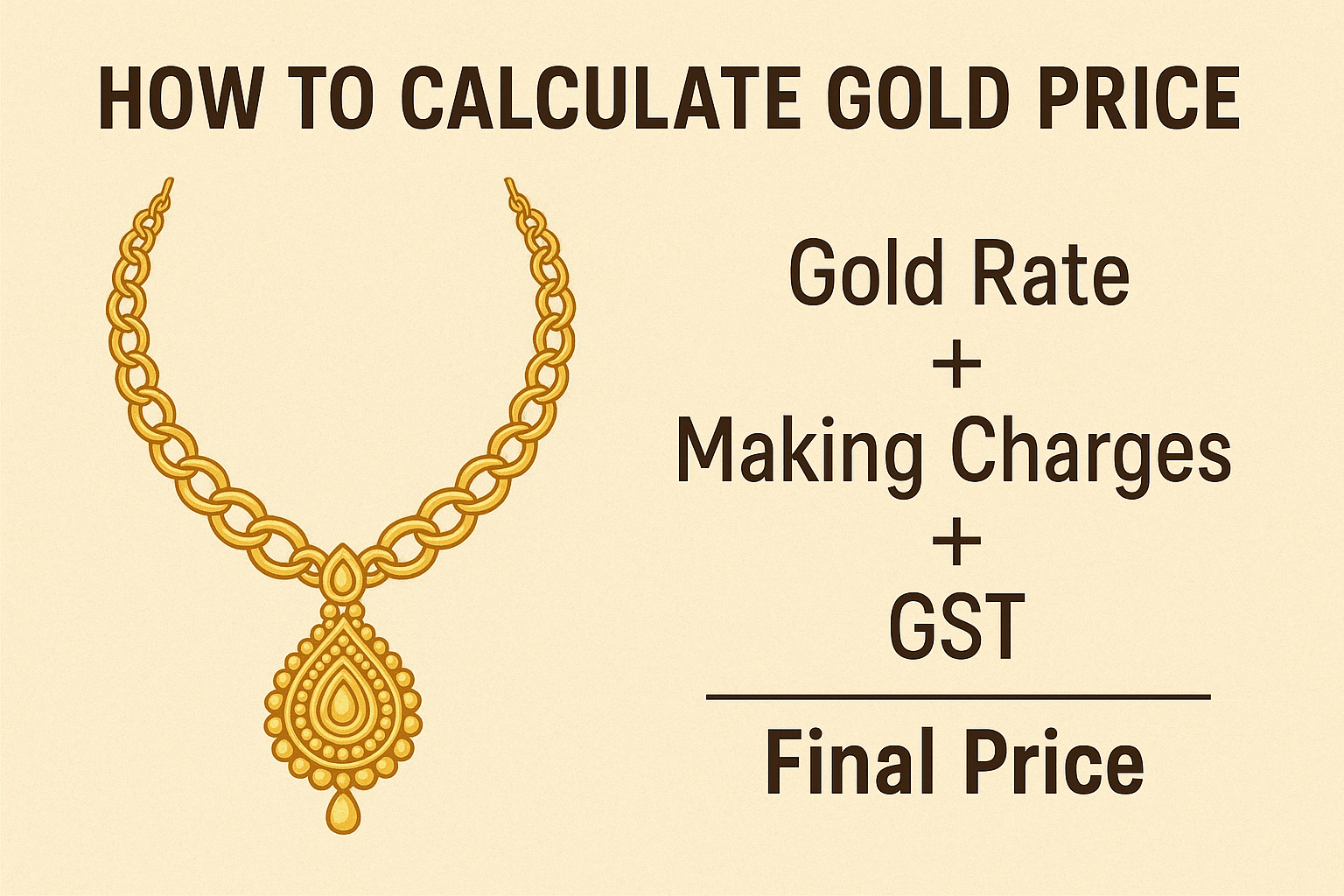
Now, let’s combine all three components to calculate gold price for the final bill.
Final Price = (Cost of Gold) + (Making Charges) + (3% GST on Gold Value) + (5% GST on Making Charges)
Let’s use our ongoing example:
-
Cost of Gold = ₹82,440
-
Making Charges (12%) = ₹9,892.80
-
Subtotal (Before GST) = ₹82,440 + ₹9,892.80 = ₹92,332.80
Now, calculate GST:
-
GST on Gold Value (3% of ₹82,440) = ₹2,473.20
-
GST on Making Charges (5% of ₹9,892.80) = ₹494.64
-
Total GST = ₹2,473.20 + ₹494.64 = ₹2,967.84
Final Invoice Price = Subtotal + Total GST = ₹92,332.80 + ₹2,967.84 = ₹95,300.64
You can round this off to ₹95,301.
To make this easier, here is a summary table of the calculation:
| Component | Calculation | Amount (₹) |
|---|---|---|
| Gold Value (22K, 15g) | 6000/g * 0.916 * 15g | 82,440.00 |
| Making Charges (@12%) | 12% of 82,440 | + 9,892.80 |
| Subtotal | 92,332.80 | |
| GST on Gold (3%) | 3% of 82,440 | + 2,473.20 |
| GST on Making (5%) | 5% of 9,892.80 | + 494.64 |
| Total GST | + 2,967.84 | |
| Final Price | 95,300.64 |
Pro Tips for a Smart Gold Purchase
-
Always Ask for the Breakup: A reputable jeweler will always provide a detailed invoice breaking down the gold cost, making charges per gram or %, and GST separately. If they hesitate, consider it a red flag.
-
Negotiate the Making Charges: The gold rate is non-negotiable as it’s a global market price. However, making charges are often flexible, especially on higher-value purchases. Don’t be shy to negotiate on this front.
-
Understand Hallmarking: Always insist on buying BIS Hallmarked jewelry. This certification guarantees the purity (e.g., 22K916) and weight of the gold, protecting you from fraud.
-
Compare Total Price per Gram: To compare deals across jewelers, calculate the total price per gram: Final Price / Weight in Grams. In our example, ₹95,301 / 15g = ₹6,353.4 per gram. This metric includes everything and allows for an apples-to-apples comparison.
Conclusion
Understanding how to calculate gold price with GST and making charges is not just about math; it’s about becoming an empowered consumer. The journey from the advertised “gold rate” to the final bill involves added layers of artistry (making charges) and regulation (GST). By demystifying this process, you can appreciate the true cost of your jewelry, ask the right questions, negotiate effectively, and ensure your investment is both beautiful and sound. Remember, knowledge is the most valuable asset you can bring to a jewelry store.
Frequently Asked Questions (FAQs)
Q1: Why is there a 3% and a 5% GST? Why not a single rate?
The government differentiates between the “goods” (the physical gold) and the “service” (the labor of making it). The value of the gold is taxed at 3%, while the service of crafting it is taxed at the standard service rate for jewelry, which is 5%.
Q2: Are making charges the same as “wastage charges”?
No, they are different. Making charges are purely for labor and design. “Wastage charges” are a controversial fee some jewelers add, claiming a certain amount of gold is lost during the crafting process (e.g., filling, polishing). Many modern jewelers have abolished this and include it in the making charges. Always ask if wastage is being charged separately.
Q3: Is GST applicable on gold coins and bars?
Yes, but the calculation is simpler. Since there are no making charges, a flat 3% GST is applied on the value of the gold coin or bar. Additionally, if you are buying from a brand, they may add a small premium over the market rate, which would also be included in the taxable value.
Q4: What is a reasonable making charge percentage?
This is highly subjective and depends on the design. For simple machine-made chains or plain bands, 8-12% is reasonable. For more intricate designs with detailed work, 15-20% is common. For specialized artisanal heritage work like Meenakari or Jadau, it can be 25% or higher. The key is to understand what you are paying for.
Disclaimer: This article is for educational and informational purposes only. The gold rates and tax structures mentioned are based on prevailing Indian market conditions and are subject to change. Readers are advised to consult with a certified jeweler or a financial advisor for precise calculations and advice before making any purchase. If you have any concerns regarding the content of this post, please visit our DMCA page for guidance on content removal and verification procedures.