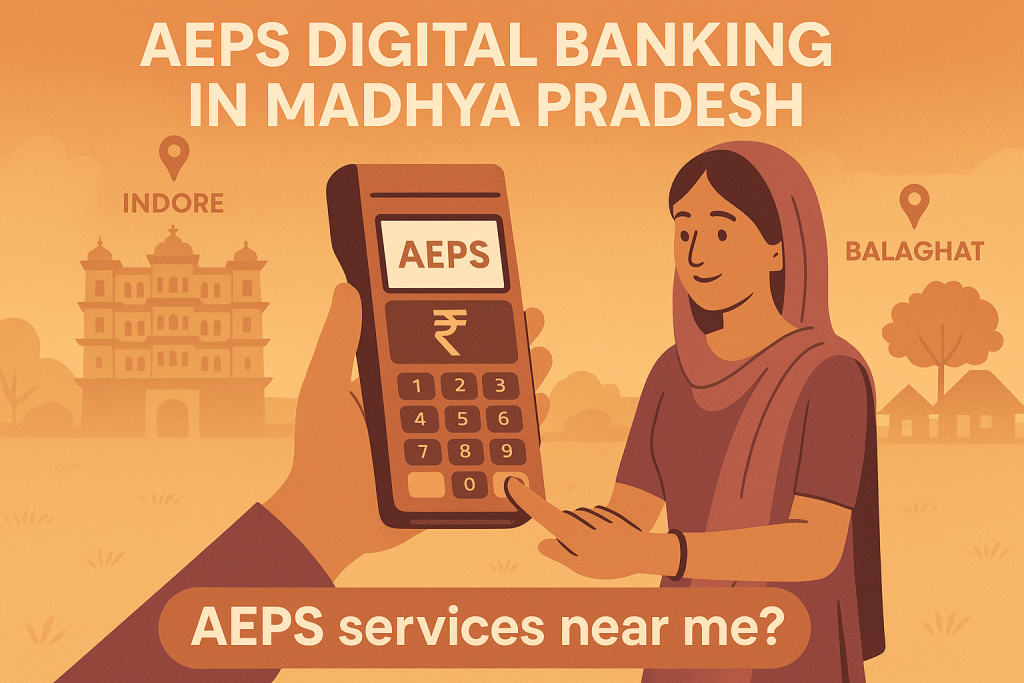
In the heart of India, a quiet financial revolution is unfolding. For millions in Madhya Pradesh, from the bustling streets of Indore to the remote villages of Balaghat, accessing basic banking services no longer requires a long journey to a distant bank branch. The hero of this story? AEPS Digital Banking in Madhya Pradesh. This powerful tool is bridging the gap between traditional finance and the digital future, empowering citizens with the convenience of cashless transactions right at their doorstep. If you’ve ever wondered, “Where can I find AEPS services near me?”—this comprehensive guide is for you.
What Exactly is AEPS Digital Banking?
Let’s break it down simply. AEPS, or Aadhaar Enabled Payment System, is a bank-led model that allows you to carry out basic financial transactions using only your Aadhaar number and biometric authentication (your fingerprint or iris scan).
Think of it as a mini-ATM that doesn’t need a card. Instead of a PIN, your unique fingerprint is your password. The system verifies your identity against the central Aadhaar database and facilitates the transaction directly through your linked bank account.
The core transactions you can perform with AEPS Digital Banking are:
-
Cash Withdrawal: The most popular service, allowing you to withdraw money.
-
Cash Deposit: You can also deposit cash into your account.
-
Balance Enquiry: Instantly check your bank account balance.
-
Mini Statement: Get a quick overview of your recent transactions.
-
Aadhaar to Aadhaar Fund Transfer: Send money directly to another person’s Aadhaar-linked bank account.

Why is AEPS a Game-Changer for Madhya Pradesh?
Madhya Pradesh, with its vast rural landscape and significant agricultural population, has historically faced challenges in achieving total financial inclusion. Physical bank branches are often sparse in remote areas. AEPS addresses this head-on.
-
Financial Inclusion at Scale: It brings banking services to the last mile. A small shop in a village can become a banking point, serving hundreds of residents.
-
No Need for Smartphones or Internet: Unlike UPI, which requires a smartphone and internet, AEPS works on a micro-ATM device that only needs a mobile data or landline connection. This is crucial in areas with poor internet connectivity.
-
Security and Simplicity: Your biometrics are unique and nearly impossible to forge, making transactions highly secure. For the elderly or those less literate, remembering a fingerprint is easier than a complex PIN.
-
Boosting the Digital Economy: By normalizing cashless transactions, AEPS is a critical building block for Madhya Pradesh’s digital infrastructure, aligning with both state and national initiatives like the Digital India campaign.
Finding AEPS Digital Banking Service Locations in Madhya Pradesh
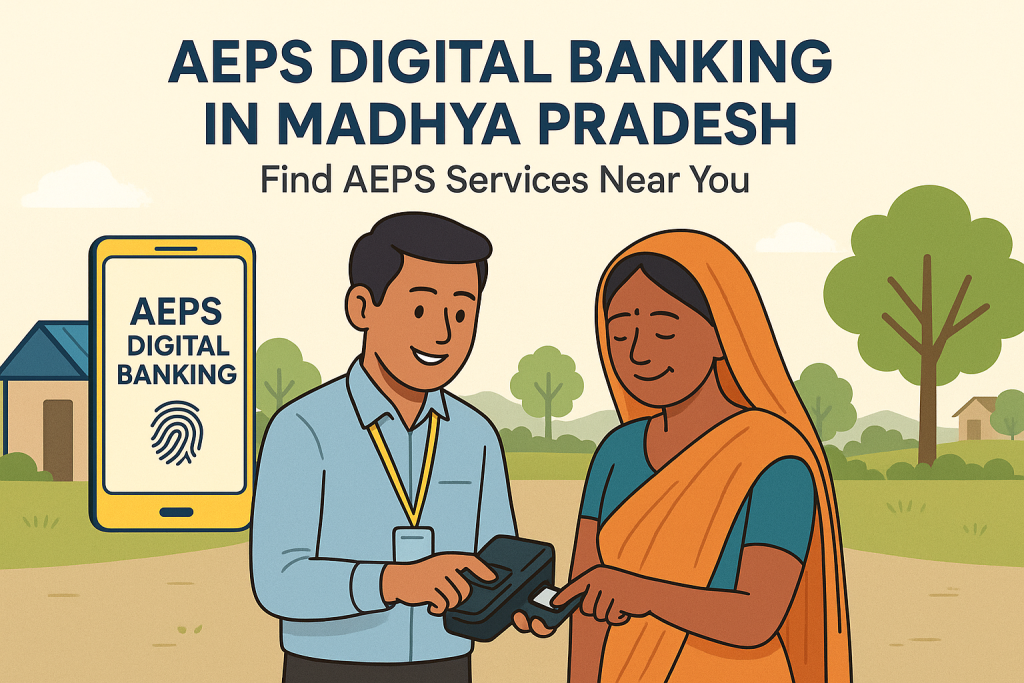
So, where do you find these services? The beauty of the AEPS ecosystem is its decentralization. You can find AEPS service points, often called Customer Service Points (CSPs) or Bank Mitras, in numerous locations.
Common AEPS Service Points Include:
-
Local Kirana and General Stores: Many small shopkeepers have become AEPS agents.
-
Common Service Centres (CSCs): These government-affiliated centres are a primary hub for AEPS and other digital services.
-
Pharmacies and Medical Stores: Increasingly offering this convenience.
-
Business Correspondents (BCs) of Banks: Appointed by banks specifically to provide services in unbanked areas.
How to Locate a Nearby AEPS Center:
-
Use Your Bank’s Mobile App/Website: Many banks, like SBI, Punjab National Bank, and Bank of India, have locator features for their BCs and micro-ATM points.
-
CSC Locator Portal: The official CSC SPV website (www.csc.gov.in) has a “Locate CSC” feature where you can find your nearest centre.
-
Ask Around: In many towns and villages, the best method is still word-of-mouth. Ask your neighbors or local shop owners—they often know the most accessible and reliable AEPS agents.
-
Third-Party Apps: Some fintech companies that provide AEPS services have their own agent locator tools.
A Step-by-Step Guide to Using AEPS Services
Using an AEPS service is straightforward. Here’s what to expect:
-
Visit a Service Point: Go to your nearby AEPS agent (CSP or Bank Mitra).
-
Provide Your Aadhaar Number: Tell the agent you want to perform an AEPS transaction and provide your 12-digit Aadhaar number.
-
Select Your Bank: Choose your bank’s name from the list on the agent’s micro-ATM machine.
-
Choose the Transaction Type: Specify whether you want to withdraw cash, deposit, check your balance, etc.
-
Authenticate with Biometrics: Place your finger on the biometric scanner connected to the device.
-
Complete the Transaction: Once your fingerprint is verified, the transaction is processed. You will receive a small printed receipt confirming the details.
Pro Tip: Always count your cash in front of the agent and ensure you collect the transaction receipt. This receipt is your proof of the transaction.
The Future of AEPS in Madhya Pradesh
The potential for growth is immense. The Government of Madhya Pradesh, in collaboration with banks and fintech partners, is continuously working to expand this network. The integration of AEPS with other services, such as Direct Benefit Transfer (DBT) for schemes like PM-KISAN, ensures that subsidies reach the intended beneficiaries securely and efficiently, directly into their Aadhaar-linked bank accounts.
As technology evolves, we can expect AEPS to become even more integrated with other platforms, offering a wider range of services and further solidifying its role as the backbone of rural and semi-urban digital finance in the state.
Conclusion
AEPS Digital Banking in Madhya Pradesh is more than just a payment system; it’s a tool of empowerment. It has democratized access to finance, ensuring that every citizen, regardless of their location or technological proficiency, can participate in the formal economy. By knowing how it works and where to find it, you are equipped to leverage this powerful system for your financial needs. So, the next time you need to withdraw cash or check your balance, look beyond the traditional bank—your nearest AEPS service point is likely just around the corner, ready to serve you with the touch of a finger.
Frequently Asked Questions (FAQs)
1. Is AEPS safe to use?
Yes, AEPS is very safe. It uses your biometric data (fingerprint/iris), which is unique to you and stored securely with the UIDAI. No one can replicate your fingerprint to access your account.
2. Do I need to have a smartphone to use AEPS?
No, that’s the biggest advantage. You do not need a smartphone, an app, or an internet connection on your phone. The transaction is processed through the agent’s micro-ATM device.
3. What if my fingerprint is not recognized?
This can happen due to rough skin, cuts, or aging. In such cases, you can use an iris scan if the device supports it. Alternatively, you can visit your bank branch to update your biometrics in the Aadhaar database.
4. Are there any transaction charges for using AEPS?
For customers, most basic AEPS transactions (like cash withdrawal and balance enquiry) are free of charge, especially when done at your own bank’s BC. However, some agents may charge a small fee for the service, particularly for cash withdrawals from other banks. It’s always best to confirm beforehand.
5. Which banks in Madhya Pradesh support AEPS?
Virtually all major public and private sector banks in India support AEPS, including State Bank of India (SBI), Punjab National Bank (PNB), Bank of India, HDFC Bank, ICICI Bank, and many regional rural banks. As long as your bank account is linked with your Aadhaar number, you can use AEPS.
Disclaimer: This article is for educational and informational purposes only. The details regarding service locations, charges, and bank policies are subject to change. Readers are advised to verify the information with their respective banks or authorized AEPS service providers. If you have any concerns or issues with the content of this post, please visit our DMCA page for guidance on content removal and to address any ownership-related matters.