For millions in India’s rural villages, a simple task like withdrawing cash or AEPS service near me checking a bank balance once meant a long, expensive trip to a town miles away. Today, the game-changing solution often lies within their own panchayat boundaries. The quest for “AEPS service near me” is being answered not by distant bank branches, but by innovative, panchayat-wise banking points. This is the story of how a AEPS service near me technology-led initiative is weaving financial inclusion into the very fabric of rural India.
What Exactly is AEPS and Why is it a Lifeline?
Before diving into the panchayat model, let’s understand the engine powering this change: the Aadhaar Enabled Payment System (AEPS). In simple terms, AEPS is a biometric-based banking system that allows you to use your Aadhaar number and fingerprint to perform basic transactions at a micro-ATM. You don’t need a debit card, PIN, or even a smartphone. Just your 12-digit Aadhaar number and your fingerprint—linked to your bank account—are enough.
The core services offered are:
-
Cash Withdrawal
-
Cash Deposit
-
Balance Enquiry
-
Mini Bank Statements
-
Aadhaar to Aadhaar Fund Transfer
For rural populations, especially the elderly, farmers, and migrant workers, AEPS is a lifeline. It removes the fear of forgetting PINs, the hassle of managing cards, and the dependence on others for banking. But the critical question remained: How to bring these AEPS points to the last mile? The answer emerged through a decentralized, community-centric approach.

The Panchayat-Wise Model: Banking at Your Gram Panchayat’s Doorstep
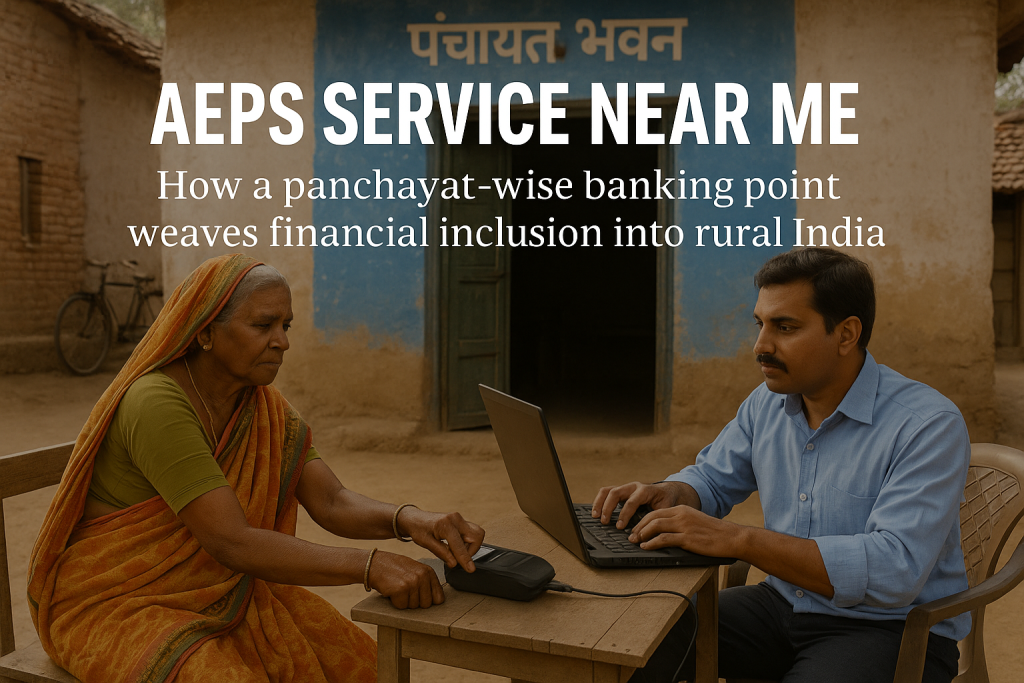
The real revolution in accessing AEPS service near me is the strategic rollout of banking service points aligned with India’s Panchayati Raj system—the local self-government at the village level. The idea is straightforward yet powerful: establish at least one accessible banking outlet in every Gram Panchayat (which often covers a cluster of villages).
These are not full-fledged banks. They are typically:
-
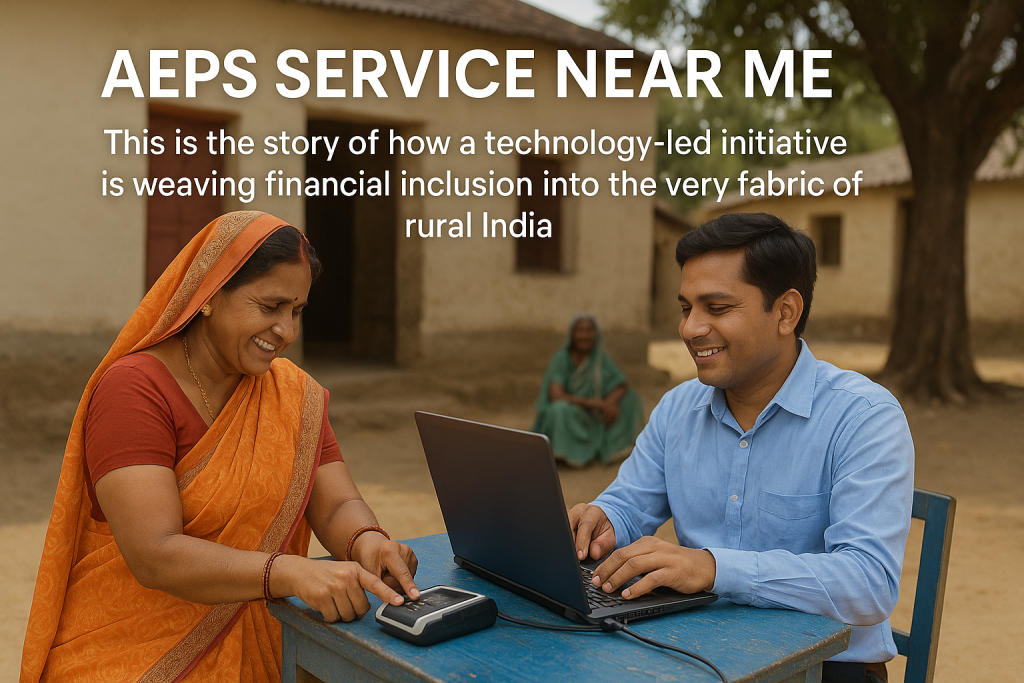
Banking Correspondents (BCs) or Customer Service Points (CSPs): Operated by individuals (often local entrepreneurs) equipped with a micro-ATM, a biometric scanner, and a smartphone/laptop.
-
Common Service Centres (CSCs): Digital kiosks set up by the government to deliver various e-services, including AEPS.
-
India Post Payments Bank (IPPB) Access Points: Leveraging the massive postal network.
Why the Panchayat-Wise Focus Works:
-
Trust and Community: The operator is usually a known face from the village or a nearby one, building immediate trust—a crucial factor in financial transactions.
-
Reduced Travel and Cost: A villager no longer needs to spend ₹50-100 on bus fare to withdraw their own ₹500 pension. The service is within walking or cycling distance.
-
Accessibility: These points often operate for longer hours and sometimes even on weekends, unlike formal bank branches with strict timings.
-
Synergy with Schemes: Most government welfare schemes (pensions, MGNREGA wages, PM-KISAN) are Aadhaar-linked and directly credited to bank accounts. AEPS service near me at the panchayat level allows beneficiaries to withdraw this money instantly and securely right in their village.
A Day in the Life of a Panchayat Banking Point
Consider the village of Sundarpur, Gram Panchayat. Sukhdev, a local CSP, opens his small shop by 8 AM. His setup is simple: a dedicated corner with a chair, a tablet with banking software, and a biometric device.
-
By 9 AM: A group of elderly women arrive to collect their widow pensions. They place their finger on the scanner, confirm the amount, and receive cash along with a printed slip—all in under 3 minutes.
-
By 11 AM: A farmer comes to deposit a small cash savings amount directly into his account before heading to the fields.
-
In the Evening: A migrant worker’s wife uses the AEPS balance enquiry service to confirm that her husband has sent money home from the city.
This micro-economy keeps vital cash flowing locally, saves countless workdays, and empowers every resident with financial agency.
The Tangible Impact: Numbers and Narratives
While comprehensive panchayat-wise data is evolving, the broader trend is undeniable. According to a Reserve Bank of India (RBI) report, as of 2023, over 12.6 lakh Banking Correspondent (BC) touchpoints are operational across India, a vast majority in rural areas. The National Payments Corporation of India (NPCI), which operates AEPS, processes over 80-90 million AEPS transactions monthly.
A case study from Odisha highlighted that after deploying panchayat-wise CSPs under a state-led initiative, the average distance to a banking point reduced from 7 km to under 2 km for over 80% of villagers. The time spent on a banking trip was cut by over 70%.
Challenges on the Ground
The model isn’t without hurdles:
-
Connectivity Issues: Erratic internet and power supply in remote villages can disrupt transactions.
-
Transaction Limits: Low daily transaction limits (often ₹10,000) can be restrictive for larger needs.
-
Awareness Gaps: Some residents, particularly women, remain unaware of the services or are hesitant to use technology.
-
Viability for Agents: Low commission per transaction can sometimes make it challenging for CSPs to sustain operations.
The Road Ahead: Strengthening the Network
The future of finding reliable AEPS service near me in rural villages hinges on:
-
Tech Augmentation: Using offline-enabled devices and solar-powered solutions to combat infrastructure gaps.
-
Agent Empowerment: Providing better incentives, training, and multi-service portfolios (like insurance, bill payments) to CSPs to improve their sustainability.
-
Digital Literacy Drives: Panchayats collaborating with banks to run regular camps, especially targeting women and senior citizens.
-
Integration with Panchayat Portals: Imagine a state’s e-Gram Panchayat portal having a live map showing the nearest AEPS service point, its operating hours, and agent contact details.
Conclusion
The search for “AEPS service near me” in rural India is no longer a cry of frustration but a testament to a quiet revolution. By anchoring banking services at the panchayat level, India has created a scalable, inclusive, and human-centric financial infrastructure. It’s a model that recognizes that for true financial inclusion, the last mile isn’t just a distance—it’s a barrier that can only be broken by bringing the bank to the people’s doorstep. As this network matures, the dream of a financially empowered rural India, where every citizen can access their money with dignity and ease, is steadily becoming a reality.
Frequently Asked Questions (FAQs)
1. How can I find an AEPS service point near me in my village?
You can:
-
Ask your Gram Panchayat office. They often have a list of authorized Banking Correspondents (CSPs).
-
Contact your bank branch (the one where you hold an account) and ask for the nearest BC/CSP location.
-
Check the website or customer care of your bank for a “locate BC” feature.
-
Use the NPCI (National Payments Corporation of India) website which provides a mapper for BC locations.
2. Is AEPS service safe to use?
Yes, it is highly secure. It uses your biometric fingerprint (Aadhaar authentication), which is unique to you. No one can transact without your live fingerprint. Always ensure you get a transaction receipt and check your balance regularly.
3. What documents do I need to use AEPS?
You only need your 12-digit Aadhaar number and your fingerprint linked to that Aadhaar and your bank account. It is mandatory to have your bank account linked with your Aadhaar to use AEPS.
4. Are there any charges for using AEPS?
For basic services like cash withdrawal, balance enquiry, and cash deposit, the government and RBI have mandated zero charges when done at a BC (CSP) point. The agent is paid a commission by the bank. However, always confirm with the agent beforehand.
5. What if the AEPS machine says “Authentication Failed”?
This usually happens due to:
-
Poor fingerprint quality (dry hands, cuts). Try moistening your fingers.
-
Your Aadhaar biometrics are not updated. You may need to visit an Aadhaar enrolment centre to update them.
-
Your bank account is not correctly linked to Aadhaar. Contact your bank to verify the linkage.
6. Can I use any bank’s AEPS service at any panchayat point?
Yes, AEPS is an interoperable platform. An agent with a micro-ATM can serve customers of any bank that is part of the AEPS network (which includes almost all major public and private banks).
Disclaimer: This article is for educational and informational purposes only. The specifics of AEPS services, charges, and agent availability may vary based on location, bank policies, and government guidelines. Readers are advised to confirm details with their respective banks and authorized service agents. If you have any concerns regarding the content of this post, please refer to our DMCA policy page for guidance on content removal and resolution of ownership-related issues.